August 14, 2009

Using the "Align to Decimal" tab in InDesign

Set a character for the decimal tab.

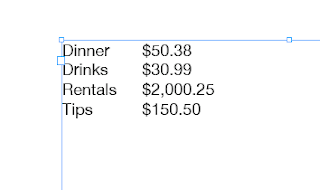
This tutorial will demonstrate how to line up items in a list. 

In this example I will be using 2 columns of information, and aligning the decimals in the second column.


1) Type your information. Press the "Tab" key to separate your left column from the right.

If your dollar signs do not line up, don't worry. This may happen if your first column contains a lot of text.


2) Open the Tabs palette (Type>Tabs)


3) Click on the "Align to Decimal" icon in the top left.

When you click this button, notice that the "Align On" box becomes highlighted. Click on the white text field here, and type in the decimal or period.

4. Now you must tell InDesign where you want the decimals to line up.

Select all of your text and click on the ruler on the Tabs bar. A new "tab" will appear on this ruler.

5. You can move the tab manually, or specify the exact numeric location.

To move the tab manually, simply click on the tab icon on the ruler(It's circled in red in the above diagram), and drag it left or right.

To set the exact location, click on the field following the "X:" Type in the value and press return.


*Note if you specify a "Left Justified" tab before an "Align to Decimal", the decimals will not align. Remove the "Left Justified" tab and allow your decimals to align.

You can also view
Adobe's tutorial here.

July 10, 2009

specialization vs globalization

I started writing this post a few weeks ago. In the meantime, I've started reading "Brave New World" which ties in perfectly with this topic. I hope to post another blog dedicated solely to that book.

The more successful we we are in our fields or career, the more we know about the area in which we are working. This sounds like common sense, but lets dig deeper.
In high school our knowledge and education is diverse- everyone learns about Science, English, and Math. Once we reach college, that field of study has been narrowed down, and by the time we graduate, we know what rather specific job we'll be diving into(well, we hope). As we work for a company our knowledge becomes so finely tuned into that specific area- it often becomes difficult to replace a person- they have a specific niche into which only they fit nicely.
Our life is a metaphorical pyramid. When we're young your knowledge base is vast. As we age, the subjects we learn about are increasingly slim(yet more focused). Maybe a pyramid with sides shaped as exponential curves would be a better illustration.

Our career goal is to understand one area specifically, and then if we're lucky, our company or position will grow. If we're reaaally lucky we'll go global- and then understand how our product interacts with the rest of the world.
The positive side of this is growth- by knowing your product inside and out- you have expanded it to huge proportions. Your knowledge has surpassed that of your rivals, and now you have succeeded.
The downside is that once you dive into your specific area, it becomes harder to see outside of it. How does your idea or product affect the rest of the world. Lets pretend that we just made a fantastic air-conditioner, that is sleek, aesthetically pleasing, and produces very few harmful by-products. When designing the unit, we are thinking, "how does my air conditioner benefit others", and "How will the design aid the ease of use", etc. But in reality should we be thinking "do people need this?" Really, what are the social, economic, moral, and religious views of what I'm doing. How do my actions influence others and what will they think of me in the end. Is this something that's going to leave me feeling empty, or will I feel like I've accomplished something by the end of the day. I mean, it's just an air conditioner. So what if it won "environmental standards" awards for emissions and energy usage. Humanity has survived without air conditioners for centuries- and most of us lived.(The ones who didn't died from far worse things than heat-stroke).
Once we specialize in a field, it's not our job to think of those things. We're so focused on our task at hand, that we can't or don't step back and look at the larger picture. And I mean the BIG picture.

February 24, 2009

b. james branding

www.bjamesbranding.com/mobile

This is a website which has been carefully designed, while considering the user experience. Things that we thought about while designing the site were- sound, mood, size of images, and overall experience. What did we want the user to come away with, and how are they moved and motivated. Have we effectively conveyed our process and our approach? Do our visitors truly understand what we do, or will they ask for "just a logo design".

December 19, 2008

Art Defined I

David, Degas, Dale Chihuly.
They all create art. They look nothing alike. Their meanings, mediums, and sources of inspiration are very different. Ranging from biblical characters to abstract Japanese flowers, how can these items be categorized into one group called "fine art". Or just simply, "art".
Most people I talk to about this topic are reluctant to do so. They have their own view of what art is, and what they like in art. However, they can't quite put a finger on what is and what isn't. The definition is what they can't quite figure out. I can't blame them, and it's not that the common man doesn't "understand art". Sure, some people aren't educated in form, shape, line, and balance, but that's not the deciding factor in this matter. What is, is that there is not definition.
As a society we want to categorize everything neatly.
Since art has changed over thousands and thousands of years, so has the definition. It doesn't fit into a neat tidy package saying "art". It is difficult to write requirements for something to be, or become art. It is interpreted. It occurs in a particular place and TIME. What was the artist feeling, and what was his motivation? He/she takes the personal experience and twists it into something new.